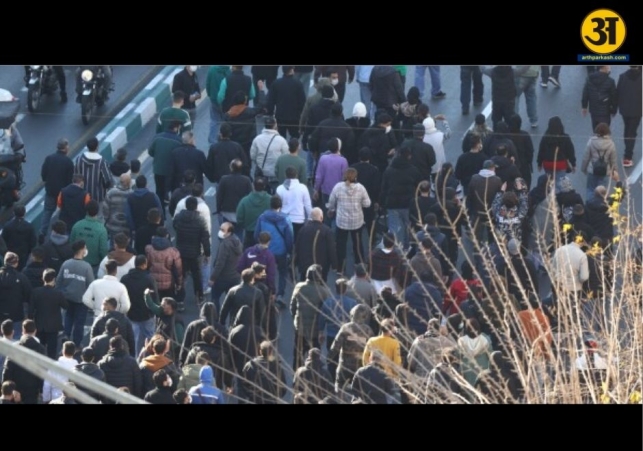
Unrest spreads across Iran amid worsening economy
Seven killed as economic crisis fuels widespread protests across Iran
- By Gurmehar --
- Friday, 02 Jan, 2026
Iran is facing widespread protests across the country after years of economic hardship. At least seven people have died in the unrest, and many others have been injured. The protests are being described as the biggest in Iran in recent years and show growing public anger over rising prices, unemployment, and the falling value of the country’s currency.
The demonstrations began because of Iran’s weak economy, which has suffered for many years due to international sanctions. These sanctions were mainly imposed by the United States and other Western countries over Iran’s nuclear programme. According to recent reports, Iran’s inflation rate reached 42.5 per cent in December, making daily life extremely difficult for ordinary citizens.
As food prices, fuel costs, and basic living expenses continue to rise, many people have taken to the streets to express their frustration. Videos and images from the protests have spread quickly on social media, showing angry crowds and heavy police presence in several cities.
Protests spread beyond Tehran
While protests have slowed down in Iran’s capital city, Tehran, they have spread to many other parts of the country. Reports suggest that the most intense violence has taken place in the city of Azna, which is around 300 kilometres away from Tehran. Security forces were seen trying to control large crowds in this area.
In several videos shared online, gunshots can be heard as protesters shout slogans like “Shameless! Shameless!” These scenes have raised serious concerns about public safety and the use of force to control the unrest.
Experts say this is the biggest wave of protests in Iran since 2022. That year, the country saw massive demonstrations after the death of 22-year-old Mahsa Amini while she was in police custody. The current protests show that public dissatisfaction has not gone away and may be growing again.
According to Iran’s state-run news agency IRNA, a 21-year-old volunteer from Iran’s Revolutionary Guard was also killed during the violence. The agency said the young man was a member of the Basij force, a volunteer wing of the Revolutionary Guard. However, IRNA did not give many details about how he died.
A deputy governor in Lorestan province, Saeed Pourali, said the Guard member was killed during clashes with protesters. He stated that the volunteer was “martyred” while trying to maintain public order. Pourali also said that at least 13 members of the Basij force and police officers were injured during the unrest.
Iranian officials have blamed the protesters for the violence. They have said that while people have the right to raise their concerns, violence should not be used as a way to express anger.
Economic pressure and political tension
Iranian authorities have admitted that the protests are linked to economic problems. Officials say people are suffering due to inflation, currency fluctuations, and rising costs of living. They have stated that citizens’ voices should be heard carefully and respectfully.
However, the government has also warned that protests should not be taken over by individuals who want to create chaos or take advantage of the situation for personal or political gain. Officials believe that such people turn peaceful protests into violent clashes.
The unrest is happening at a very sensitive time for Iran. The country is still dealing with the impact of recent military actions by Israel and the United States. The US has also carried out strikes on Iran’s nuclear facilities, adding to tensions in the region.
In an attempt to ease pressure, Iran has said it is no longer enriching uranium at any site in the country. This statement appears to be aimed at showing the West that Tehran is open to negotiations over its nuclear programme. Iran hopes that talks could lead to the lifting or easing of harsh economic sanctions.
So far, however, no major talks have taken place. Relations between Iran and the United States remain tense. US President Donald Trump has warned Iran against restarting or expanding its nuclear programme. Israeli Prime Minister Benjamin Netanyahu has also issued similar warnings.
Many analysts believe that the ongoing protests reflect deeper problems within Iran. Years of sanctions have weakened the economy, reduced job opportunities, and lowered living standards. Ordinary citizens are feeling the pressure more than ever.
As the situation continues, the world is watching closely to see how the Iranian government responds. Whether the authorities choose dialogue, reform, or stronger action may shape the country’s future in the coming months.
For now, the protests have sent a clear message: many people in Iran are struggling to survive and want urgent change to improve their lives.
Related News